Personal Memories of "The Final Fantasy Legend"

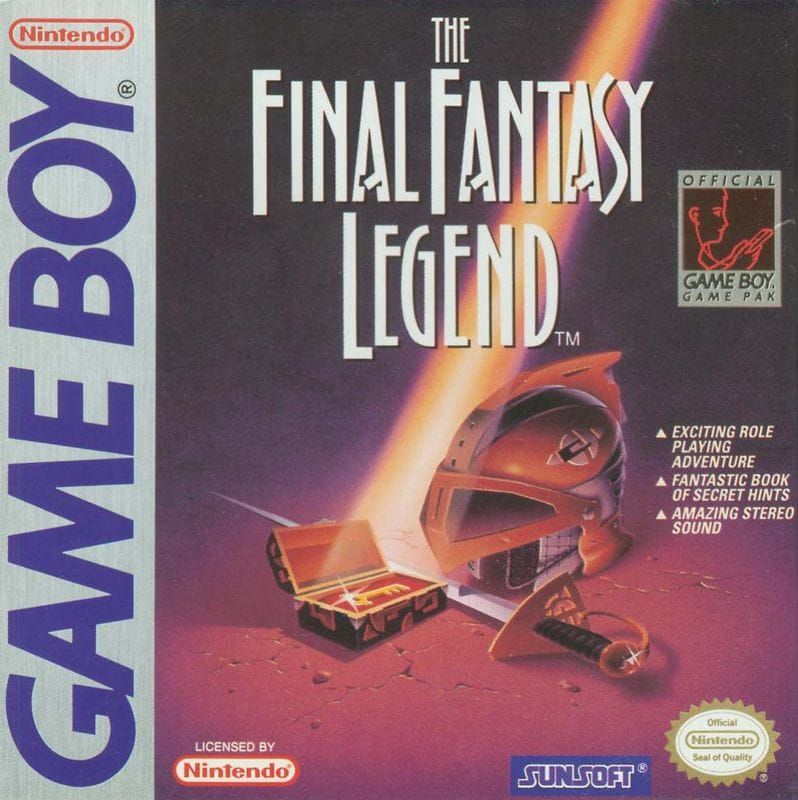
Back in November, I did a livestream playing the Game Boy game "The Final Fantasy Legend". When I was a kid, I owned the first three "Final Fantasy Legend" games and "The Final Fantasy Adventure" on Game Boy, and I can remember spending lots of time on car rides taking each of these games with me. At the time, I remember "Legend" being kind of confusing. It wasn't totally clear where I was supposed to go and what I was supposed to be doing. Learning new abilities and transforming my monsters didn't make a lot of sense to me, either. However, with a little bit of a guide to help me understand navigating from one place to another, the game is actually quite simple to tackle from beginning to end.
I should stress early here that although this game has "Final Fantasy" in the title, the reality is that it's not really a "Final Fantasy" game at all. Rather, it's the first in the now long-running "SaGa" franchise—specifically "Makai Toushi SaGa", or "Demon World Tower Warrior SaGa"—, and the only reason it has "Final Fantasy" in the title in the west at all is to bank on that sweet, sweet name brand recognition. Regardless, it does still get lumped in as a "Final Fantasy" spin-off, and that's not wholly inaccurate, given the development team had just come off the "Final Fantasy" franchise.
"Legend" has a lot of similarities in character development to "Final Fantasy II," thanks in no small part to director Akitoshi Kawazu, who was also the designer for that game. "Final Fantasy II" is unique to a lot of other games in the "Final Fantasy" franchise in that leveling up various skills is a bit of a grind and a challenge. In that game, using a skill levels up that skill. Using a kind of magic levels up your proficiency in that kind of magic. Getting hit with attacks raises your defense and HP, that sort of thing. "The Final Fantasy Legend" also has particularly unique ways of leveling up your characters. You have a choice of building out a party of four characters who can be humans, mutants, or monsters. Humans gain strength and health by purchasing growth items to be used on those characters. Mutants get stronger simply by being used in battle, and will occasionally learn new abilities. And monsters grow and transform into other monsters with various abilities by eating the meat of their enemies after you've defeated them. Monsters can be fun for this reason, but during this particular play through of the game, I wasn't especially interested in trying to keep an eye on the exact enemies I would need to eat at what points to grow my monsters in an optimal fashion. Instead, this time I chose a party of a male and a female human, and a male and a female mutant. Over the course of the game, you do sort of have to be particularly mindful of your characters' health. When they die, it is possible to bring them back to life, but you can only do it a total of three times before they're dead for good, and once that happens, you'll have to go to a specific NPC to roll up an entirely new character from scratch. Luckily for me during this run, I never had any character reach that threshold, and I was kind of successfully powering through almost the entire thing.
The initial starting point is probably the hardest the game will ever be. Your characters are really weak and can barely handle any fights with any monsters outside of the starting town. On top of that, you don't have enough money to be able to afford the weapons and stat boosts that would really serve to help you. For that reason, your first couple of hours will likely be little more than a grind, running around in circles outside the first town just to get enough money to be able to handle the enemies around you. But at a certain point, you'll finally have the right weapons and abilities, your mutants will be getting strong and running laps around your humans and carrying your whole party, until finally you will earn enough money to buy your humans all the way to victory. By simply grinding for money early on, I found my characters very quickly incredibly overpowered, and it made playing the rest of the game incredibly easy. Most of my video game streams will take a pretty long time to beat, over the course of multiple sessions, but with "The Final Fantasy Legend," it only took me three sessions of give or take about three hours each to beat (plus a little bit of extra grind while nobody was watching). Surely, the whole game took me less than 15 hours total.
Your party starts at the base of a large tower—the tower named in the Japanese title of the game. NPCs will tell you that it's rumored that the tower rises all the way to paradise. Presumably, your party has decided they wanna get up there and see if paradise is real or not. Over the course of the game you will slowly climb up this enormous tower, stopping at a handful of unique worlds with their own unique environments along the way, in an attempt to see what's really at the top of the mysterious tower.
The game is just a very Japanese take on a fantasy RPG genre. "Final Fantasy" is also obviously made by the same Japanese company, but it pulls a lot from many ideals of western fantasy elements. "Legend", however, features a lot of very Japanese enemies, pulled from Japanese history or fiction. Four of the major bosses in the game include the legendary Four Gods found in Chinese and Japanese fiction: Gen-Bu, Sei-Ryu, Byak-Ko, and Su-Zaku. You have probably heard these names used in other pieces of Japanese fiction, such as in anime like Fushigi Yuugi or Yu Yu Hakusho. One of the highest floors of the tower takes you to the World of Ruin, which is actually just Tokyo as an apocalyptic wasteland. You even have to go exploring through Akihabara to find pieces of electronics that will help you defeat Su-Zaku. As I said, this is a very Japanese kind of fantasy game.
Weapons and abilities are interesting, because they are not limitless. Your mutants can learn new abilities, but once they start using them, it is in fact possible to run out of them after using it 30 times. The same goes for weapons. There were a couple of times that I had mutants with some cool magic abilities like fire that could hit a whole group of enemies, but once they ran out, if they didn't also have a weapon equipped, then they literally could not do anything with their turn at all, making them completely useless. The game also comes with pretty cool weapons. You don't only get swords and other melee weapons, but you also get a variety of guns and bazookas, meaning this isn't strictly a medieval or a Sengoku-period fantasy, but also one with some modern flare sprinkled in. But what's really killer is the chainsaw (simply called "Saw" in the localization due to limited translation space). Apparently, it was intended to be programmed to have a 50% chance to instantly kill any enemy weaker than you. However, through what is believed to have been a glitch or a programming mistake, it actually does the complete opposite, giving a very likely possibility that you will one-shot anything stronger than you. For this reason, it is entirely possible to kill the final boss in a single hit using nothing but the Saw. And that's exactly what I did. And while that seems like it may be too easy to feel very rewarding, I disagree. If I can kill God in one hit, I absolutely also feel like a god myself. This game absolutely rules.
Navigation is sometimes really difficult, and part of that is due to a clunky translation. "Legend" didn't get nearly the translation attention of other Square games, and that's saying a lot when you consider how little attention any other "Final Fantasy" game got to its translation up until about "Final Fantasy VIII." There's weird grammar and punctuation, strangely broken sentences, and speech doesn't exactly sound natural. On top of this, there are wide open areas in the game with no clear directions given to tell you where exactly you need to go. Without a guide and a map, it's pretty easy to just stumble around lost forever. But the second you look up just those two things, the game kinda becomes a cakewalk. And honestly, I'm not even mad about that. I kinda like this game exactly the way it is.
"The Final Fantasy Legend" is the only one in its trilogy to have its soundtrack completely composed by famed "Final Fantasy" composer Nobuo Uematsu. Uematsu of course is a phenomenally talented musician, and hearing what he's able to make a Game Boy's sound chip do is kind of incredible. The opening title screen and text crawl features a track that has floated around in my memories for decades, sort of sweet and haunting. What a great soundtrack for such a small, pocket-sized game.
I am hesitant to spoil the ending of this game, when you finally reach the top of the titular tower. But for a game with nothing much in the way of a true narrative, there's a neat and unexpected twist at the top. The reveal left me smiling, because I really didn't see it coming. Just really fun writing that manages to shine through, even through an extremely limited translation.
"The Final Fantasy Legend" was re-released in Japan for the WonderSwan color (or rather, I should say "Makai Toushi SaGa" did), and while this version was never released outside of Japan in any capacity, a fan translation patch of the game does exist. It might be fun to revisit what many consider to be the definitive version of that game one day. Until then, English-speaking fans can also find the Game Boy version of "The Final Fantasy Legend" re-released for more modern consoles in "COLLECTION of SaGa FINAL FANTASY LEGEND", which bundled together games "I", "II", and "III" into one package. If you want to try it the way it was originally released, along with its two sequels, this is a good way to do it. I plan on getting around to "Legend II" and "III" later this year, so I'll eventually be doing write-ups on those games as well.

Thank you to all of my Patreon subscribers for making writing about my thoughts and experiences possible. Blogs like this are able to happen more often with your kind support. If you are interested in becoming a member and seeing the perks available, please consider subscribing to my Patreon.
Special thanks to the following Phobos and Mars tier members: Scott Sandler, BetaRayILL, Mannekwin, and MB.
Extra special thanks to Kasei Gumi members Joe Goes Over, Gomer, and 27 cubic meters of seawater.
