Playing "Halo" for the First Time (While Living Through Fascist America)

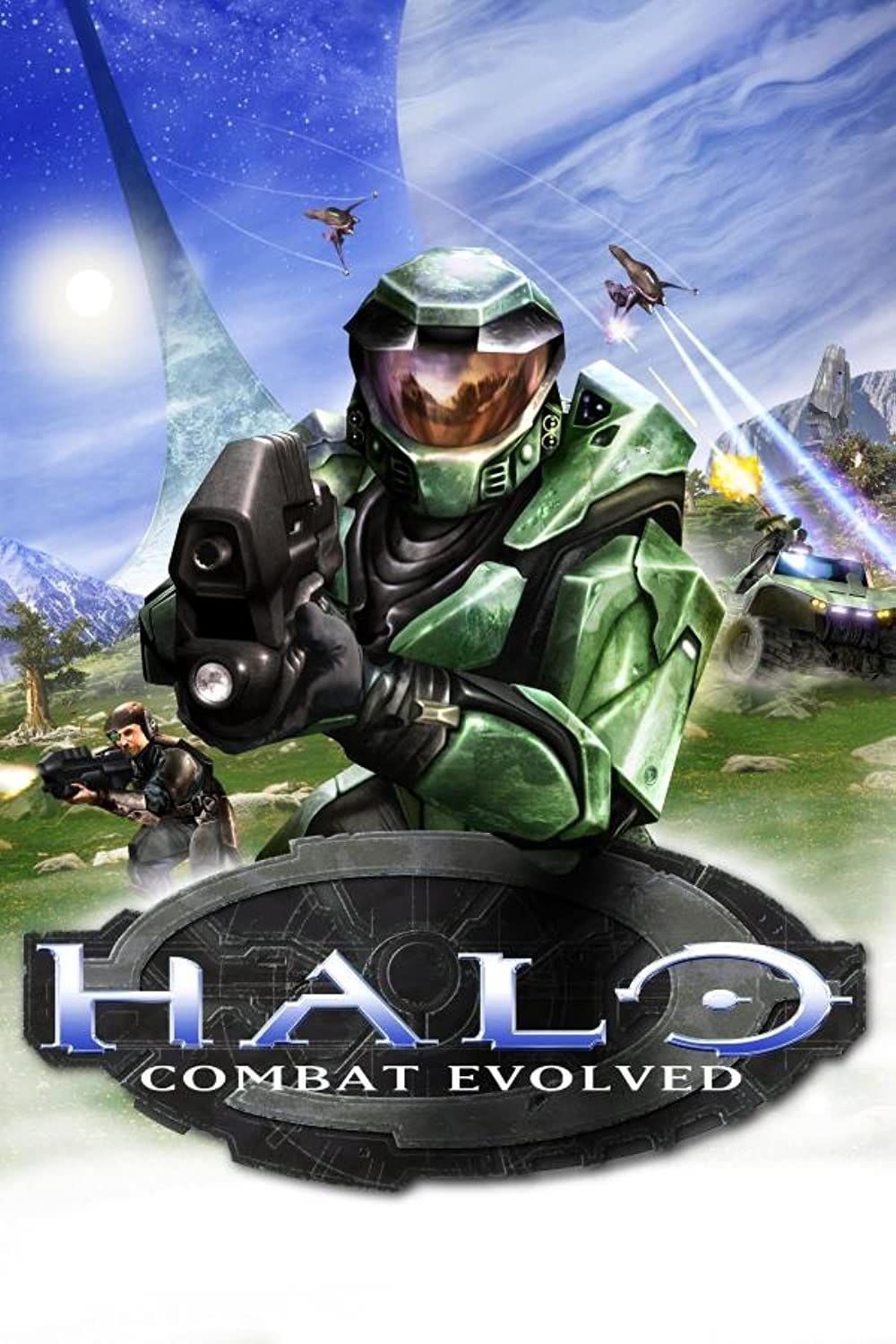
After posting on Bluesky asking for twelve game recommendations to play throughout the year 2026, one friend suggested that I finally play "Halo: Combat Evolved". This past week, I finally completed the game, through "The Master Chief Collection". It's interesting playing a game that released 25 years ago for the first time. Or, at least, it's my first time playing through the campaign. For at least "Halo 1" and "2", I remember frequently going to friends' houses and sitting in their living rooms playing split-screen multiplayer for hours on end. To that extent, I was already quite familiar with many of "Halo's" mechanics. I could easily tell you who Master Chief was, what a Warthog was, what a Needler was, etc., but I would never have been able to tell you the plot of the game. And it took me 25 years to even learn what it was actually about.
I'm sure there are plenty of people who will read this who have been long since initiated into the "Halo" franchise and find a lot of this description pretty simplistic. "Halo" begins with the Master Chief—a member of a group super soldiers developed by the Marines called Spartans—being awoken from cryosleep in the year 2552 on a space colony named Reach. Suddenly, the colony is attacked by a collective group of enemy alien forces known simply as the Covenant. Reach is destroyed, and only one ship containing Master Chief and a few others manages to make a quick get-away. The ship is damaged and lands on a mysterious world in the shape of a giant ring (that would be the titular Halo). Master Chief, carting around the ship's female-presenting AI named Cortana in his helmet/skull, along with several members of the Marines, search the world of Halo for clues as to what it is, and why there appears to be a rather large abundance of members of the Covenant there. Nobody's too sure at first what exactly Halo is. The Covenant seem to think of it as some sort of holy or religious site—or actually, maybe it's true purpose is as a weapon. Regardless, Master Chief goes farther into the depths of the world, into bases scattered across the surface, fighting the alien Covenant army, who give no answers as to what they believe Halo's significance is to their people.
But somewhere around the middle of the game, a new problem is discovered. Deep inside of Halo, there's an entirely different problem laying buried inside. A new enemy awaits everyone on the world—the Flood: an alien parasite that attaches itself to any life form it can find, kills it, and zombifies it, using it to attack other life forms and continue it's unrelenting spread across species, worlds, and galaxies. And Halo was where it had been safely contained, until its doors had just now been opened up. "Flood" is certainly an appropriate term. Some of the smallest parasitic monsters you see in the flood come in overwhelming droves, defeated only by an onslaught of gun spray. Then you fight Covenant aliens that have clearly been zombified, and even zombified human Marines who also sadly didn't make it. How do you stop such a relentless force? The Covenant now hardly seem like the real problem in this story.
This is when you're introduced to a small, floating, orb-like robotic entity called 343 Guilty Spark, who speaks with gentle authority, as if it has all the answers to this overwhelming problem. They say that they've been keeping the Flood locked away here, but they know exactly how to stop them. They now need your help as Master Chief to activate Halo, destroying all of the Flood in the nearby universe. 343 Guilty Spark convinces Master Chief to run around collecting what's necessary to activate this procedure, and just as he's about to set everything in motion, Cortana (who had been struggling to communicate with Master Chief up until this very moment) suddenly jumps in to warn him that, hey, actually, sure, this will destroy the Flood—but that's because it will destroy all known life in the nearby universe, too. 343 Guilty Spark admits that this is accurate, but being the kind of entity they are, they totally don't get what the big deal is. Isn't it worth it to wipe out the Flood? Cool, so now we have yet another problem to worry about. When Master Chief decides that, hey, activating Halo would be bad actually, now he's gotten himself on the bad side of 343 Guilty Spark and their robot compatriots. Literally everything is against us now. Now that we know the truth of what the Flood is, as well as what Halo is and what it does, it's up to Master Chief and his AI companion Cortana to destroy Halo for the greater good of the universe.
It's not an overly complicated story. I don't know what I thought Halo was really about all these years. And I suppose with having now only played "Combat Evolved", I still don't actually have the full picture of what the universe is totally about. But aside from the atmosphere of Military Except It's In Space And In The Future, I really didn't have a clue for 25 years what "Halo" really was. No amount of multiplayer or even watching multiple seasons of "Red vs. Blue" really tells you enough of what's actually in the story of the game. Being that I was a teenager when the first game released, I did sort of let the stereotypes of certain kind of gamers color my impression of what I thought "Halo" was. There was a very unfortunate stereotype that came with Xbox gaming in general. It's a lot less noticeable in more modern generations, what with most gaming not being exclusive to one particular platform (aside from some Nintendo properties) which has flattened the archetypes of people with loyalties to particular platforms. In fact, it feels like platform loyalty is practically non-existent by comparison to the gaming of yesteryear. Why would we need that platform loyalty? If I can play "Yakuza" on a PS5, a Nintendo Switch 2, an Xbox Series X, or a PC, then who cares what console you own? But in the time of the original Xbox, it wasn't that uniform. I specifically remember going to my high school friend's house, playing split-screen multiplayer "Halo" with him, and he would regularly jokingly call his console the Halo-Box, to the point where his stepdad genuinely thought that was the actual name of the console.
I played this version of "Halo" pretty far removed from its original iteration. Although I've always intended to go back and pick up an original Xbox, I still don't own one. I did this run on my PC, picking up the "Master Chief Collection" some time a while back during some deep sale that made it ridiculously cheap. (I figure that's worth mentioning because many people are doing their best to abide by boycotting Microsoft as of this writing.) While I would typically prefer to play first-person shooters using a mouse and keyboard, in the case of "Halo", that felt particularly wrong somehow. It definitely needed to be done with a controller in hand, the way I remembered playing against my friends in high school and college. Even still, it probably was still technically "wrong" because I played this campaign using a modern Xbox Series X controller, and not the good ol' door stopper that was the original Xbox controller. And even past that, I would regularly press that button that would switch between original Xbox graphics and the new remastered graphics, just to get a sense of what the difference really was. Although some areas with brighter lighting in the new graphics were certainly appreciated, those new graphics were redesigned so completely that it almost felt like the developers were embarrassed by what "Halo" was originally intended to be. Colors, textures, light sources—everything was wildly, drastically different from its original appearance. In a lot of areas, it felt like an entirely new game had been built, and that certainly was not always for the better. I certainly understand the value in those darker environments when you see that the game designers had given you a flashlight to help you navigate those areas. It gives the impression that they wanted you to feel a little lost and a little spooked by your surroundings. And with the brighter environments of the new graphics, all that suspense is completely removed, and you essentially never once need to use the flashlight. I'm glad that the option exists to so easily transition between whichever graphics you prefer, but it does sort of feel like the new graphics completely misunderstood the intent of the old graphics.
But frankly, despite having technically been around at the beginning of the Xbox era and cognizant of "Halo" enough for big "Halo" parties at friends' houses, I'd say when it comes to the lore of the greater "Halo" franchise, I am still in my infancy. There's several games with lore that will eventually take me so much deeper than this surface-level story presented in the original game. But I at least feel I have learned enough from one game to be able to make some basic commentary on one particular element of the modern day cultural conversation.
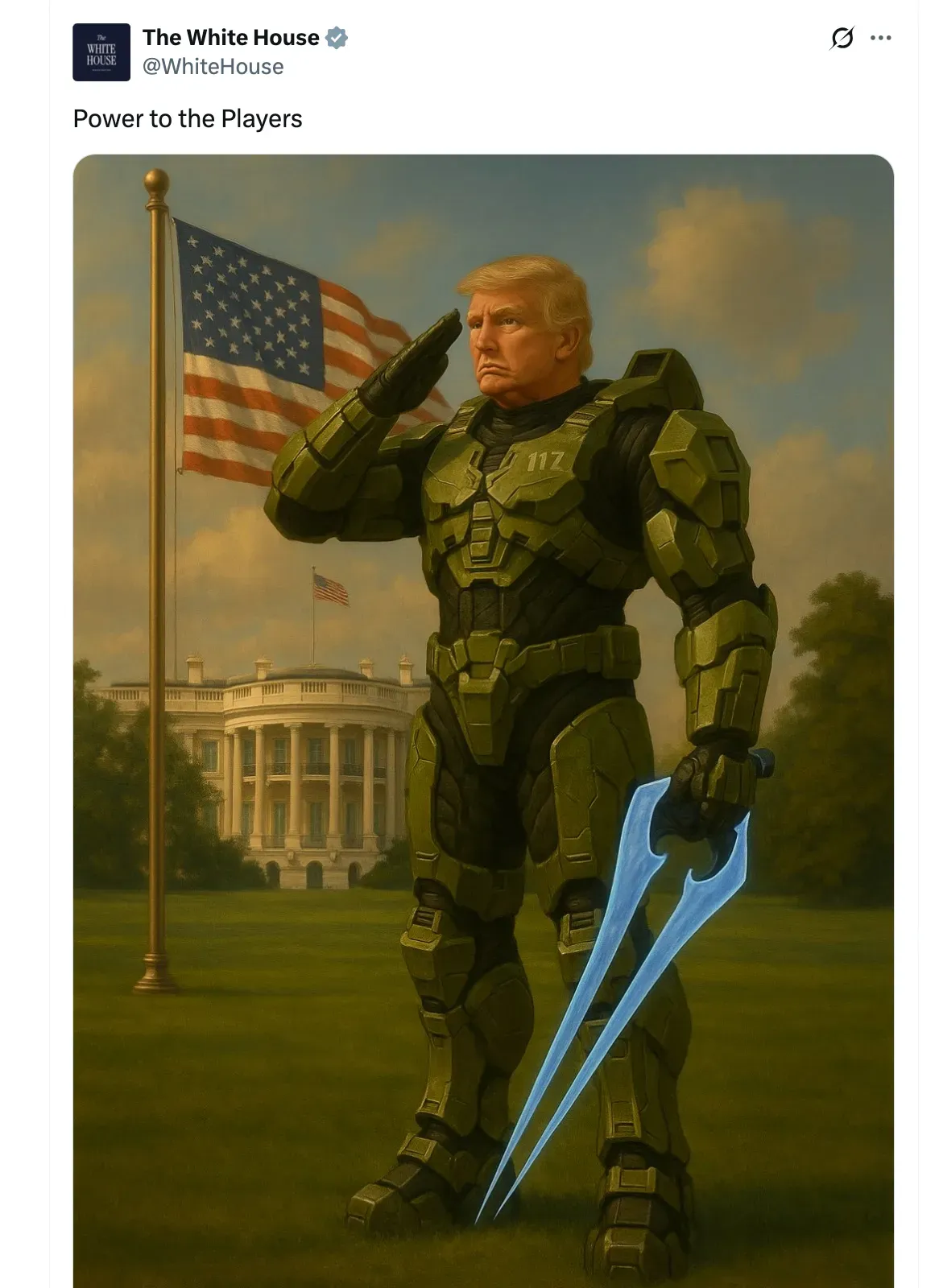
In October 2025, the White House Twitter account posted an AI-generated image of Donald Trump standing on the White House lawn, dressed in Spartan armor, saluting the American flag with his right hand, and holding an Energy Sword in his left.
The next day, the Twitter account of the US Department of Homeland Security posted a tweet using Halo imagery to encourage its followers to join Immigration and Customs Enforcement (or ICE). "Destroy the Flood. Join ICE."
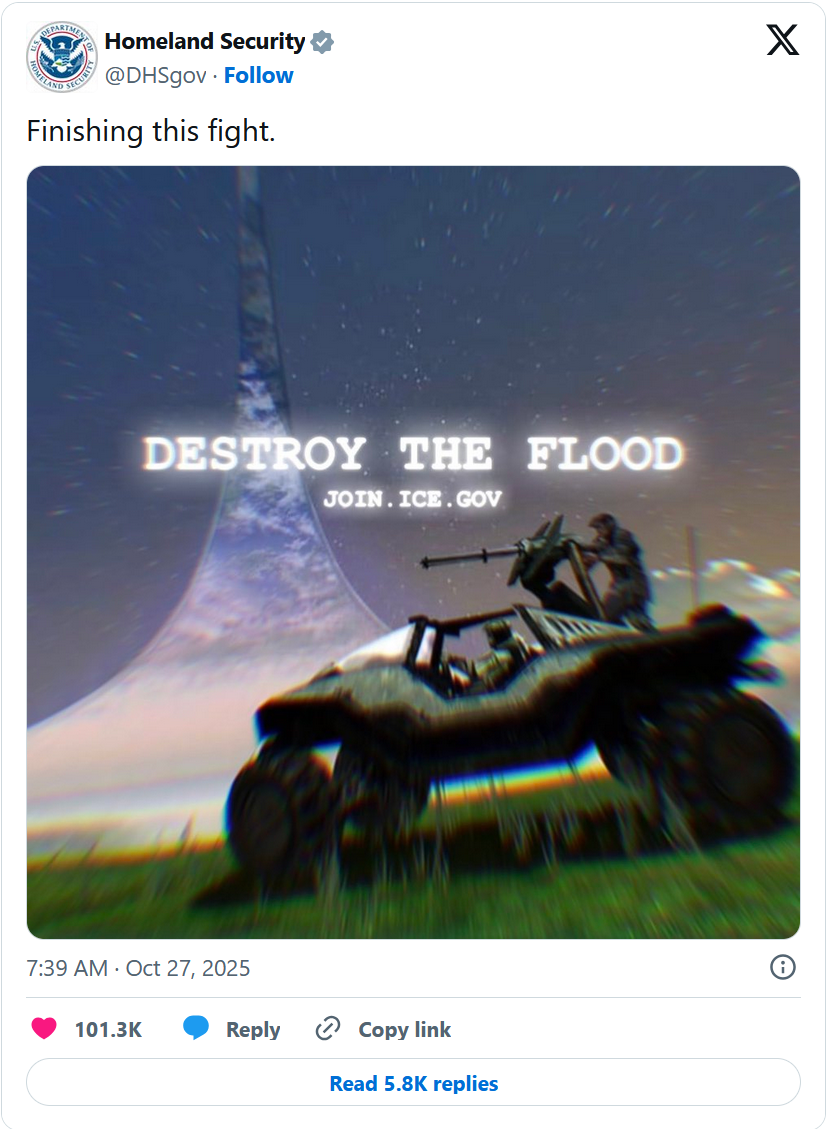
Even without having yet played the campaign of "Halo", its use in DHS's campaign to recruit ICE members was frustrating. Seeing gaming being co-opted by the United States government to pull new members into an organization that has spent the last year racially profiling US residents (both legal and undocumented alike), kidnapping them, sending them to concentration camps, extraditing them, and murdering them feels unconscionable. It is sort of insane that there is even a person who holds a position as a paid professional meme lord behind an official government social media account at all, but even more than that, using video games to promote that ideology somehow feels even more sinister. Perhaps it should be of no surprise, as it has long since been well documented that Gamergate as a movement was directly used to model and weaponize into the modern age of politics—a topic that I am somewhat knowledgeable about but perhaps not well spoken enough about to be able to elaborate upon in great detail, certainly not better than some other incredible journalists who have already done so.
But what is equally as upsetting (and also equally unsurprising) is that, to people knowledgeable about the "Halo" franchise, they will tell you that DHS's messaging totally does not align with any sort of messaging found within "Halo" itself. Thankfully, this has included some co-creators on the original "Halo". Speaking to Game File, co-creator and Master Chief designer Marcus Lehto stated the DHS post was "absolutely abhorrent", and, "It really makes me sick seeing Halo co-opted like this." In the same article, designer Jamie Griesemer told Game File, "Using Halo imagery in a call to ‘destroy’ people because of their immigration status goes way too far, and ought to offend every Halo fan, regardless of political orientation. ... I personally find it despicable. The Flood are evil space zombie parasites and are not an allegory to any group of people."
And after having played just the first game myself, I found that to be incredibly true, not even remembering what Griesemer had said specifically in response to the post by DHS. After finishing the game and lingering in my thoughts about it, I thought more deeply about the analogy to the Flood—about how they infect anything and everything and rapidly continue their spread. I understand some right-wing extremists' comparison to the Great Replacement Theory (a racist conspiracy idea that minority ethnic groups are coming to replace all the whites in America and that you should be terrified of that happening even though it isn't even remotely true), but even under that framework, that's not even what the Flood are doing to begin with. That's not what a parasite is, and that's not what a zombie is. Those are just fundamentally completely different ideas.
But even further than that, after having finally played "Halo", an entirely new allegory came to mind after the DHS post. The US government has identified a group of people as "The Flood"—a group that they deem necessary to purge at all costs. And I do mean all costs. Not unlike 343 Guilty Spark, the government has decided that in their fight to eradicate the undesirables, it is also acceptable to eradicate literally anything and everything else in the surrounding vicinity. And does that not exactly describe what we have been seeing with ICE? They didn't stop at just undocumented immigrants. They didn't stop at just murderers and other criminals. They didn't stop at those in the country legally with proper documentation. They didn't stop at naturalized US citizens. They didn't stop at US citizens born and raised in the United States. At this point, they will kidnap anyone and everyone they think they can target, and as we have only all too recently seen with numerous citizens such as Keith Porter Jr., Renee Good, and Alex Pretti, it literally doesn't matter who you are or what you're doing—our government can decide to kill you for no reason, with no consequence, under the guise of enforcing immigration (which they clearly aren't actually doing).
I stress that I am basing my viewing and interpretation of this entirely on solely the events that take place in "Halo: Combat Evolved", and I realize I have not yet seen the large bulk of the rest of the plot of the greater "Halo" franchise. That having been said, I think there is still value in viewing DHS, ICE, and the greater Trump administration as an allegory for an entity willing to destroy everything in its path just to squash the tiny number of people it hates the most. It's firing a laser from an orbiting satellite in order to hit a spider in your garage. The fact that it will destroy an entire community in the process doesn't even register as being in any way consequential to them. All in a day's work. And the only thing that makes them worse than Spark is that the people orchestrating it may in fact even derive pleasure from doing it, whereas it would seem that Spark just thinks they're being logical about it all. Regardless, the problem is still the same. There's no recognition in the value of life to be found at all. It makes them infinitely more dangerous than the people they've identified to be their so-called "Flood" (which, to be clear again, no human being is in any way comparable to a space fantasy zombie force called the Flood).
It is wild to play "Halo" so far removed from its original release, in the middle of the time period of Fascist America (which at this point may later be known as Civil War II). There will be history books and documentaries that talk about how the federal government orchestrated themselves amongst the people of their country, and how they used gaming as just one piece of their propaganda arsenal. I would be very interested in living to the end of it to see how those books and documentaries are written in the end. But as someone who was finally given a chance to jump into "Halo's" narrative, I can tell you this much without a doubt: the Department of Homeland Security either has never actually played "Halo", or they did and simply did not understand its messaging and its themes. And they most certainly are hoping you're too gamer-pilled to think too hard about the messaging, either. But you're better than that, right? I know you are. Think for just a minute about what the Master Chief of "Halo: Combat Evolved" would actually do. Would he destroy what somebody told him was "The Flood" without question? Or, once he got information about what that messaging really meant and who it would hurt, would he reject that messaging and stop the greater threat to all of life? If you're really the gamer or the "Halo" fan you think you are, you should know the answer to that. Master Chief knows who the real ultimate threat to all of life is. Point your ire at the appropriate enemy.

Thank you to all of my Patreon subscribers for making writing about my thoughts and experiences possible. Blogs like this are able to happen more often with your kind support. If you are interested in becoming a member and seeing the perks available, please consider subscribing to my Patreon.
Special thanks to the following Phobos and Mars tier members: Scott Sandler, BetaRayILL, Mannekwin, and MB.
Extra special thanks to Kasei Gumi members Joe Goes Over, Gomer, 27 cubic meters of seawater, Genante Tante, Joseph Caruth, and BLASTOWICZ.
