Thoughts After Reading "Nobuo Uematsu: On The Record"

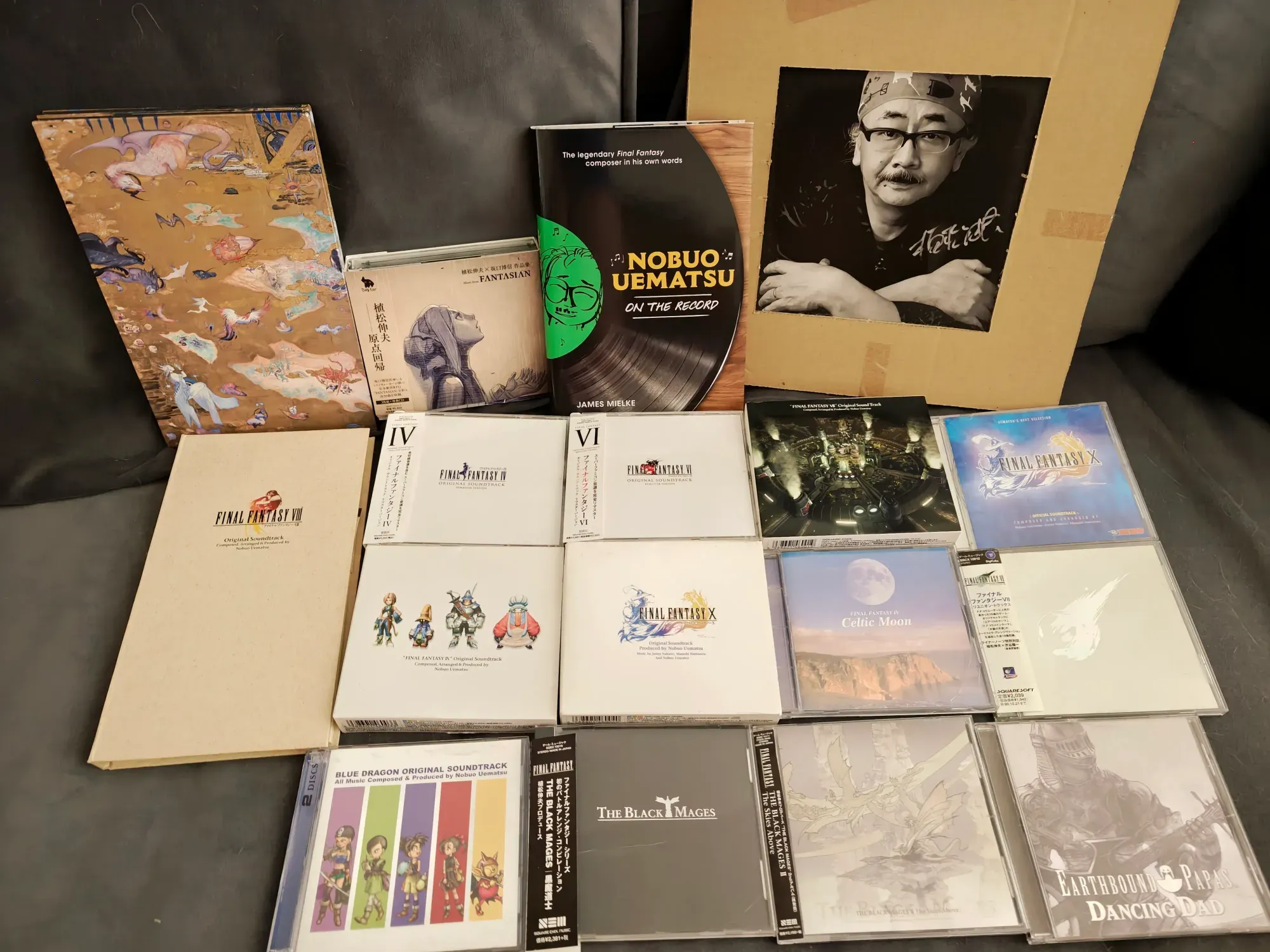
As I write this article, it has been about a week since the biography Nobuo Uematsu: On The Record, written by James Mielke, has gone on sale. Having pre-ordered the book, during times when I was not trying to wrap up work and other obligations, I spent much of my week eagerly reading this biography. And although I am someone who has paid quite close attention to the famed video game composer since I was a teenager, despite the fact that large chunks of information in the book were not new to me, there were in fact moments that were wholly new, that were intriguing, or even more humbling and humanizing. And although I'm going to be discussing how the book has made me feel in later paragraphs here, I think I'd rather categorize this post as how Uematsu's work has made me feel as an ever-present part of my my life for the past several decades.
Book trailer for James Mielke's "Nobuo Uematsu: On The Record".
My Introduction to Final Fantasy
If I had to guess, it must have been somewhere around the year 1999 that two childhood friends came over to my house one night to watch a bunch of anime and play video games. One of those two friends brought her PlayStation over to my house.
I'd had video games in my home, but we weren't an ultra-rich family that could afford too many consoles. My parents had a Colecovision from before I was born. A babysitter I had owned a Nintendo Entertainment System, but it was a console I didn't have in the house growing up. A neighbor kid had a Sega Genesis that I didn't have. But I did end up with a Super Nintendo and a Game Boy, and for a long time, those consoles served me well. But I had been behind the times as far as keeping up with new gaming developments were concerned. My friends and I were now at the end of middle school, and the PlayStation had already been out a few years, having totally left me in the dust.
The friend who brought over her PlayStation also brought two of her favorite games in tow--Final Fantasy VII and Final Fantasy VIII. I had previously maybe seen Final Fantasy II (unbeknownst to be at the time, truly was a retitled Final Fantasy IV for the sake of America) sitting on rental shelves at a Blockbuster Video the next town over, and I can clearly recall having previously rented a copy of Super Mario RPG: Legend of the Seven Stars but not understanding why a Mario game didn't play the way I understood Mario games were supposed to work, and so I gave up on it far too soon at the time. But now my friend was in my room showing my other friend and I one of her favorite games, popping Final Fantasy VII into the PlayStation now plugged into my TV, and loading up her favorite part of the game. Little did I know that she was loading up a pivotal moment somewhere right around the middle of the game where an extremely important character famously dies. When she ran the player character up to the zone that triggered the pre-rendered cutscene and said character got stabbed in the back and straight through their stomach, my friend lifted her fist in the air and shouted, "YAY!" I completely didn't understand what I was looking at. I had no idea that my absolute first exposure to Final Fantasy VII was my friend revealing to me what was perhaps the biggest spoiler in the entire game.
I remember we had stayed up all night and it was already early into the morning the next day when she also fired up the beginning of Final Fantasy VIII. I was shocked by the jump in fidelity. These looked like two totally different kinds of games. It reminded me of what a lot of PC gaming was looking like in those days, and I couldn't believe console gaming was looking like this now. Were these really from the same franchise? My friend who'd brought the PlayStation over believed that between the two of us, I would probably have a better time with Final Fantasy VII, and our other friend would most likely better enjoy Final Fantasy VIII. Unfortunately, I did not have a PlayStation of my own and was unsure of when I would ever be able to own one. Luckily, Eidos had ported Final Fantasy VII over to PC, and so my first time playing it was a very slightly different experience from playing it on a PlayStation but still had a life-changing effect on me.
Although I don't actually believe it is the best game in the franchise, Final Fantasy VII is in fact an incredible game, and it's little wonder that it has received the massive fan following that it has. And that was able to shine through even on a crappy family home computer with a soundtrack that was arguably subpar by comparison to its PlayStation counterpart. Despite this, that soundtrack--even played as bland MIDI files through a janky PC sound card--was astounding. If you listen to recordings of that older PC soundtrack today, you might come away surprised to hear how competent a port of that music really is. The battle themes were still memorable, Crazy Motorcycle was still intense, and even JENOVA sounded like a beast of a track under those conditions. The only place where that soundtrack truly suffered was, predictably, with the track One-Winged Angel. It was a track unlike anything I'd heard before, with tension and horror and unsettling tones all over the place, and the entire time I was playing that final battle (something I had to do several times before I finally figured out how to clear it), I had no idea that it was supposed to have an entire choir of vocals singing in Latin throughout it. I didn't learn this was the case until after beating the game and going out of my way to find a copy of the soundtrack on CD, listening to the discs all the way through, and suddenly being shocked to learn I had missed an entire layer to that track the entire time. I felt robbed, at least of having that experience during my initial play through. But it meant that I was going to be able to have something of a second "first time experience" all over again later.
Somehow, despite VII being the first Final Fantasy I played all the way through to completion, unlike many others with that same experience, it did not end up being what defined my understanding of Final Fantasy. Rather, it made me absolutely ravenous for more like it. I wanted more games by this same group of people. I knew that VIII already existed and looked a lot different, and I knew that the games before it weren't even 3D at all. And given that I did not yet have a staunch attachment to 3D gaming, maybe that's what made it easier to go back and consume the earlier games.
And perhaps consume isn't even the right word. I think a better word for that experience would be "inhaled". I can remember spending a summer on at least trying every single Final Fantasy that had been released up to that point in time. My mom worked at the elementary school my friends and I had previously attended in a computer lab, and somehow her lab had acquired a handful of PlayStations with the intention of using them for "edutainment" games. My mom was allowed to take one home for the summer under the condition that we also tested the edutainment games. This meant I could spend a summer renting all the Final Fantasy games that had been released and re-released on PlayStation (even if it also sucked to test these edutainment games, too--I don't even remember a single title I was asked to help my mom try out). I remember I hated the loading times for battles and various zones on pretty much every older Final Fantasy released on PlayStation. I eventually ended up downloading ROMs of the six earliest entries on their original platforms, which at the time also meant downloading some of them with fan translation patches. I would save them to a floppy disc, and then take that floppy disc to the PC I had in my bedroom that wasn't connected to the internet and just play them all in my room. It was that combination of emulation and PlayStation releases that eventually caught me totally up to speed with Final Fantasy, and I did it absolutely voraciously.
When I ran out of Final Fantasy games, I started consuming other Squaresoft-released titles. Honestly, as a teenager, I couldn't get enough. I blew through them all so fast, and it created a lifetime of memories, and started a love of rare and hard-to-acquire international releases with no translations to speak of. But even after all of this, I kept coming back to Final Fantasy, the franchise that sparked that passion for all of these things in the first place. I credit my childhood friend with a lot of setting me down this path, and I'm lucky I still communicate with her enough that I was recently able to tell her all this, too. Genuinely, just a life-changing moment of my youth that I don't think can possibly be overstated (even if it meant that I knew right from the get-go that an important character in Final Fantasy VII was going to die).
I became attached to Nobuo Uematsu's music from those Final Fantasy games so hard and so fast. In that time and age, sharing and downloading MIDI covers of your favorite songs was pretty popular, so even when I couldn't buy all the CDs I wanted, I could go out of my way to find MIDI versions of my favorite Final Fantasy tracks. I listened to them over and over again, particularly right before I had to leave the house to go to school. I would play them over the family computer's speakers, and I would sing the notes of even the most intricate melodies, and my mom would comment and say, "How do you know literally every single note?!" She was fascinated by how quickly I had learned everything, and how I could hum harmonies buried deep under the mainline melody.
The Deep Musical Background in My Own Home
I wonder, though, if she should have been so surprised, given I grew up in an intensely musical home. Even before I was born, my parents were singer/songwriters. Both of my parents were very competent guitar players, with my mom largely playing rhythm guitar and my dad doing everything from rhythm to lead guitar solos. My mom played a modicum of piano, having previously learned how to play organ as a child, and my dad had about the same experience on a keyboard. My dad also is an extremely competent bass player. Later on in life, my dad would go on to try to re-teach himself how to play violin, after having abandoned the instrument as a kid. They both sang together, and my mom in particular had a lovely singing voice. I know my mom loved Joni Mitchell, and I guess if I had to compare her voice to any other musical artist it would have to be hers. Together, my parents had performed at live venues numerous times, taking me with them on several occasions when they had a gig, and both had written numerous songs, and I can recall them recording and publishing albums in the home, both solo and along with each other, when I was still just a little kid. They played together in a band with another one of my mom's friends, but ended up breaking up when I was particularly young. Their music was clearly inspired by rock and folk music of the '60s and '70s, and I know my older cousin was greatly inspired by them both as well, and he too would go on to learn to play guitar and banjo, I'm sure among dabbling in other instruments. I think that as a kid, I didn't particularly appreciate what my family was doing musically.
Audio from my mother, Lynn Dicksion, playing guitar and singing on a song titled "As the Madness Goes Away" from her album titled "As Is", recorded sometime in the 1990s.
Unfortunately, as a small child, I mostly found myself irritated that they would take up so much time and space, that I felt like I couldn't walk around and play freely, that they were constantly practicing or recording in the house. It made me feel sometimes like I had to hide away and disappear and be quiet. When I couldn't tolerate it anymore, I had some pretty bad little kid outbursts, being mad that my mom was playing music at all. Well, you grow up and realize you were an idiot because you weren't even close to double digits yet, and there's no reason why anybody should really want music like this to stop. Although I do think I understand some of why I was upset as a child. I think I was feeling ignored and pushed to the side a lot, in favor of the music.
Sadly, my mom passed away in 2012. My dad currently has recordings of all of the music they both performed, but all I have access to is a single one of her albums, and my relationship with my dad is sadly what I would describe as "actively hostile". There is a very real chance I will never hear any of the rest of my mother's music ever again for the rest of my life, because I genuinely believe that I will be inheriting absolutely nothing and will never be able to touch any of it.
My Ten Years Playing Piano
Sometime around the age of five, my parents put me into piano lessons. At that age, that was certainly not my decision. I didn't yet actively hate piano, but I can't say that I was immediately passionate for it. In the house that I grew up in, music felt imposed onto me rather than being a choice. It was difficult for me to find music that felt especially made for me for this reason. When the first piano teacher moved away, my mom went searching for a second for me. She did in fact find a very good instructor for me, and I learned absolutely every single important thing about playing, sight-reading, and music theory from this instructor. And over the course of ten years since the start of my training at age five and a couple other instructors toward the end, I had become quite good. I was taking extracurricular music theory exams at college campuses more than an hour away.
I recently picked up an old music theory workbook I was using to study as a kid and realized it was so wildly in-depth that I barely recognized it anymore, and that I truly had taken it so much farther than I had realized. My parents were sending me to state performance competitions in Dallas, and I was coming back home with certificates and medals.
But the truth was... I wasn't passionate about it at all. Practicing felt forced. I would make mistakes on the home upright piano, and then bang on the keys because I hated even doing it at all. I hated how much time it took out of my life. I grew up in the middle of nowhere, in the rural hill country of south central Texas, and my piano teacher was more than a 45-minute drive away from the house. It made long school days feel even longer, especially when my high school was also something like 45 minutes from home, and the high school and my piano teacher were something like 30 minutes apart. I was exhausted, just absolutely constantly exhausted. I can remember my mom picking me up from school on lesson days of the week, and I would beg of her to just let me fall asleep in the car, but she would insist that if I fell asleep that I wouldn't be awake enough for lessons. I fell asleep anyway. But when we would begin our approach to my teacher's neighborhood, my mom would suddenly turn the air conditioner vents toward my face and turn the temperature to full cold at full blast to shock me into waking me up. While that did its job, it made me panicky and upset. It felt like a cruel torture technique. And by that point, there was absolutely nothing fun about the experience of going into a piano lesson. I would go in to learn music I didn't even want to play, and come out feeling every time like I was never even good enough. I hadn't practiced enough, I hadn't retained enough.
I don't know if it's impostor syndrome or not, but I really didn't feel like I was ever going to be really "good". Something about retaining both music theory and even sight-reading skills felt more difficult than it should have been. Even though to this day I can tell you how to read notes on a staff, and I can tell you that the spaces on the staff are the notes F, A, C, E and spell the word "FACE" as a short and easy way to identify a note, I would still feel like I was taking entirely too long to identify a note. I would still basically have to count up from the bottom. "Okay, if that note is on the third line of the staff, and if the first space is the letter F, then it's F, G, A... Okay, that note is a B." I didn't just know it based on sight alone, no matter how long I had been doing it. I had to just work it out, each and every single time I learned a new song, and never truly sounded like I "got" it until I had played it so many times that I'd gotten it memorized (thankfully, the end result the teacher always wanted was memorization, so it would always eventually LOOK like I was really good at it). Or, I wouldn't be able to tell you what key a song was in until I had really stared at the number of sharps or flats notated at the beginning of a song and counted them all out, and even then I would just straight up forget, particularly if a song just had an absurd number of sharps or flats. It felt like literally the only way to look like I was doing well was to just memorize the piece and forget about the music theory behind it. To this day, I have an extremely similar issue with math. People are supposed to be able to know without thinking about it that eight times four is thirty-two, but I have NEVER been able to do that kind of calculation without using elementary-level skip-counting to count out, "Okay, eight, sixteen, twenty-four... oh, okay, the answer is thirty-two." These are always things that I work out eventually, but my brain is absolutely not wired to memorize these specific things, and in the case of music, it made something that should have been quite enjoyable and beautiful out to be a chore.
It also didn't help that nobody would help me learn the kind of music I wanted to play of my own volition. I can remember times when my mom would take me to this really big sheet music store in San Antonio. It was one of the few times I would get actively excited about the idea of being around music that I could learn for myself. I remember coming back with books from Disney movies, Star Wars, and more. I remember bringing some of these books with me to my piano lessons, and I would ask my teacher to help me with lessons designed to work out how to play some Star Wars pieces. And she just... wouldn't. She did not want to teach me how to play Star Wars. It really felt like the expectation was to play nothing but classical music, because that's what all the competitions and major performances were centered around. I brought to her a book with music from the movie City of Angels and asked her to teach me Sarah McLachlan's Angel, and she made it very clear that if I was going to learn it, I was going to have to teach it to myself.
And that was one of the first times I had ever done that. I was a seventh-grader, and I spent a bunch of time teaching myself how to play Angel because I had somehow gotten permission from my choir teacher to perform it as a solo act for a concert we were putting on that year. It would also be my first time attempting to both sing and play at the same time. It was slightly imperfect, but in the end, I did it. Thinking about it now, it's a little bit crazy that at the age of about 13 I had taught myself a complex piano song by Sarah McLachlan, forced myself to sing at the same time, and did it in front of a live audience. I feel that over the years I have lost a very valuable skill that I had honed at a very young age and I'm not sure I'll ever get it back.
When eventually I was becoming increasingly passionate about video game music, and Nobuo Uematsu's music in particular, I felt like I was getting exactly the same resistance. In fact, at a certain point, I just assumed that nobody was going to take my desires to play anything other than classical music seriously. For a brief while, I was printing out sheet music from various games and trying to poke around at them myself, but I was really struggling without the assistance of a good instructor. I can remember two times when I brought some of that sheet music to high school with me. The friend who'd introduced me to Final Fantasy and I were both in the same choir class, and our choir had a woman who played piano as our accompanist while we would rehearse. Some mornings, my friend and I would show up early, and at one point we started presenting her with this sheet music and asking her if she was able to sight-read it for us. One of those pieces was Colors of the Summer Sky by composer Hiroki Kikuta from the game Secret of Mana, and another was Slam Shuffle by Nobuo Uematsu from Final Fantasy VI. The accompanist was such a good musician, she sight-read them instantaneously with absolutely no effort, and it sounded incredible. My friend and I were both just sort of in awe, completely geeking out. I never even got close to playing these pieces as well as she did.
One day, my family got a shock, and the piano teacher I had been learning from for many years had made a decision to move with her husband to Ireland. We would now be forced to start an entirely new relationship with a new piano instructor somewhere else. It really was the beginning of the end of everything. Despite feeling trapped in a cycle of Classical Music Only, I mostly had an okay relationship with my piano teacher by the end of her time with me, and I was at least grateful for the wide breadth of knowledge she had instilled in me. Now my parents were on the hunt for someone else.
After a brief amount of time, they found the first of the last two instructors I tried--the first being a college professor at Southwest Texas State University (now just called Texas State University) in San Marcos, Texas. And in fact, my parents were driving me all the way out to the college campus in San Marcos to learn from this professor. It was just yet another abysmally long drive, especially on days after school from my high school which, to be clear, was NOWHERE NEAR San Marcos. It felt impressive that at about the age of 15 I was starting to take college-level piano lessons from a college professor at a college campus, a thing that he apparently did not do often but he took an exception with me, but I cannot express how miserable I had become by this point. When I didn't latch on, my parents found yet another teacher, this time in San Antonio. And she was perfectly nice, but I was still running into the same problems. I wasn't happy. I wasn't having fun. The classes were so far away and took so much time to get to and return home from. I was being worked to my wit's end. And I wasn't playing any of the music that made me happy. After ten years, I finally told my parents that I wanted to quit. I remember that my parents had to break the news to the final instructor I ever had, and they sort of guilted me by saying, "We felt bad because she asked us, 'Was there something wrong with me?' and we didn't know what to tell her." I did feel guilty. But I was undeniably miserable. I was growing very interested in music from other places in pop culture, which was now beginning to include Nobuo Uematsu's music, and I was spending a mountain of time on things that were in no way taking me down the path towards playing that music.
A Brief Transition to Guitar
Some time around early high school, I remember I picked up my mom's guitar for the first time. I was listening to some music and trying to pick out by ear how to recreate it. My mom walked in, and as I was trying to show her how I thought I'd taught myself something I'd heard, she was just kind of mortified that I had touched her guitar, that I didn't know how to hold it or play it, that I would ruin it. I suspect that that's the reason my parents bought me my first electric guitar and gig amp, so that I wouldn't accidentally destroy their equipment.
It's funny. Despite the fact that my parents had decades of history playing guitar and songwriting, when they saw I was beginning to build an interest in playing guitar myself for my own musical interests, they spent essentially no time helping to cultivate that in me at all whatsoever. I didn't think much of it at the time, but looking back at it now, I do think it's kind of weird. Maybe my mom did once bring me some reference material to teach myself how to play a few basic chords. And then... that was it. I was left to my own devices. I don't know why my mom didn't jump at the chance to sing and play with me, when I know that's what she loved. And my dad, well, he was working so much that, quite frankly, he barely saw me or ever even knew me on a personal level at all and already spent hardly any time with me in the first place.
Generally, I think like many kids, my parents had a pretty big distaste in my own choices of music. I'd begun listening to rock music of the late '90s and early 2000s and started trying to emulate that sound. I'd learned how to tune the lower E-string down and started playing heavy metal and nu metal songs with these super simple power chords that sounded really angry and distorted. I remember being really excited when I'd first taught myself how to play Nobuo Uematsu's Otherworld from Final Fantasy X this way, minus the wailing and screeching of the lead guitar solo, which I was not at all skilled at.
But it was through the guitar that I was finally able to find myself playing the music I wanted to play, including tracks from Final Fantasy. It was where I was finding myself experimenting quite a lot and teaching myself things without supervision from anyone else. And the early days of the internet helped me to find a lot of things I couldn't figure out on my own. I eventually found myself plunking out chords until I'd figured out a rough approximation of what sounded like Uematsu's Eyes On Me from Final Fantasy VIII. And it was at yet another choir concert during high school that I ended up performing it in front of an audience. I'd found a sweater with long sleeves and a particularly long tail in the back that, although it was red and not blue, reminded me very much of Rinoa from FFVIII, and I played the chords I'd taught myself by ear and sang solo in front of a bunch of parents and family friends.
Unrelated to Final Fantasy, when I was 18 years old and my choir was performing the last "Pops" concert I'd ever perform in (a concert held every year where students got to perform popular music), another friend of mine and I had rehearsed a guitar duet cover of Shawn Mullins' song Santa Fe, which we had once again taught ourselves by ear, both playing and singing together. It was the first time that I had tried allowing my friend to play a portion of the song's rhythm guitar while I taught myself a guitar solo in the middle. I remember just finishing the solo section, and the song wasn't even over yet, but when my solo was done the audience was already cheering and applauding because it was totally unexpected. It was a feeling I'd never have before, and would never have again.
I mention all of this because I know that recordings of many of these things exist somewhere out in the world. There's recordings of me performing on piano, there's recordings of me performing publicly on guitar, playing and singing all at once. And yet I do not possess a single recording of any of these things. I know someone associated with the Smithson Valley High School choir around the graduating class of 2004 has these recordings. Someone once promised to send me recordings of our concerts, which would have also been fascinating to look at because at one point in time I was in three different honors choirs at once (Varsity Womens, Varsity Mixed, and the Broadway Ladies--a small pop music ensemble). And yet no one has ever delivered on getting any of these recordings to me. I know recordings of me as a child playing piano exist somewhere in my dad's house, and I will probably never hear any of those ever again, either. Almost all of my musical background will likely forever be lost to time.
I think I would have stuck closer with any of these musical endeavors if I had ever felt at any point in time that I was supported in any of the kind of music I actually wanted to perform. If lessons weren't a 45-minute drive away and a 45-minute drive back, if anybody had even once embraced the kind of music I was beginning to find that I myself enjoyed, if my family had watched me pick up the guitar and tried to interact with me about it on any level at all whatsoever (honestly, how can singer-songwriter parents never want to talk to their child with a budding interest in guitar--the very instrument that they spent years of their lives playing and writing music with?).
I remember one time I had bought a disc called Final Fantasy VII Reunion Tracks. Most of the short selection of tracks were pulled directly from the game, but the last three tracks on the disc were some of the first orchestrated compositions of Final Fantasy VII's music, including Main Theme of Final Fantasy VII, One-Winged Angel, and Aerith's Theme. My mom actually really liked Aerith's Theme and Main Theme of Final Fantasy VII. But I played the disc in the car with both my parents one day, thinking maybe they could appreciate the video game music now that it was being performed by a live orchestra and sounded like real classical music. For whatever reason, my dad heard it and insisted, "That's not a real orchestra. Those are fake instruments. Sorry to disappoint you, but you can make a synthesizer sound like any real instruments these days." All he heard was that it was music that came from a video game, and despite the fact that I played the versions of the songs that were in fact actually from the game back-to-back with their orchestrated counterparts, he was not convinced. He genuinely just believed he was right. It really upset me. I think my mom had to later talk him into apologizing to me for insisting on it as hard as he did.
But I say this to show that there was basically zero understanding in my household of the music I was beginning to embrace. It wasn't taken seriously because it was almost like the music wasn't even real music. It didn't matter that Nobuo Uematsu had a history of digging into classical music, or that he loved many of the same folk, pop, and progressive rock bands that my parents were clearly inspired by when they were writing their own music, and it didn't matter that so many of his compositions when analyzed closely enough can be tied back to his love of the very artists that my parents had purchased tons of records from and were sitting in our very house at that moment. All anybody saw was "Video Game Music", and that meant it may as well not have been music at all. And after that, it was inevitable that I would grow out of love with performing.
I still own an electric keyboard, and I still own an electric guitar and a gig amp (thanks in large part to my friend Nash and numerous others for helping me reacquire a new guitar and amp after the theft of my previous guitar from a storage unit). I sometimes pick up goofy little instruments like the Otamatone and the melodica. I sing to myself plenty still. But despite an attempt to instill a love of performing music in me, the truth of the matter is that my home situation very nearly drilled it out of me completely. Sometimes I think that maybe at my current age I could finally just throw away whatever trappings I believed I was in and just start playing that music that I always wanted to play when I was younger. I still haven't quite made the time.
A Passionate Musical Return After Reading the Biography
But maybe now, after having read Nobuo Uematsu: On The Record, that time is closer than ever.
There is quite a lot about Uematsu written in this book that you could probably ascertain if you have spent years reading about him in various interviews like I have. How some early Final Fantasy soundtracks came together, overcoming certain technical limitations, and even some things like his interest in the occult and UFOs have mostly been public knowledge for a while. But hearing it not only from his mouth but also from the mouths of his contemporaries and others who once worked at Square across the timeline of various games does give it a sense that it is more true and real because there are numerous people backing those stories up. Even his musical preferences and inspirations are not necessarily new information here, and I've seen even newcomers to Uematsu's musical pieces listen to his work and come away knowing exactly what songs he had previously been inspired by because it comes through so plainly in his work.
Learning more specifically about Uematsu's childhood is perhaps one of the areas that has been much less explored in other previously-published interviews. I am hesitant to give away all of the details about it because I think it's best if you read the book for yourself, but seeing a progression laid out of Uematsu's various childhood interests and things that he pushed himself to to without someone else telling him to do it was very fascinating. I was aware that Uematsu had been a fan of wrestling (he's interacted on numerous occasions with my own favorite wrestler Kenny Omega, a wrestler who is also very blatantly inspired by Uematsu's work), but not that Uematsu had once considered becoming a wrestler himself so strongly that he'd actually taught himself how to do a backflip. The mental image of Nobuo Uematsu performing a backflip now is nearly impossible for me to conjure!
But it's the move into discovering music and teaching himself piano in late childhood and into his teenage years that was something I truly envied. Reading about it in the book, you really get a sense that it was something he pursued as hard as he did because he had become so very passionate about the music he was hearing and wanted to make that music himself, having been inspired by countless notable creators. It's an experience I am very jealous of. What would my own adventures into playing music have been like had I not essentially been forced into piano? What if the expectations of those around me hadn't been so strictly set around only classical-style music? What if piano had felt like a choice and not a chore? What if I'd had the time and the freedom to purse the music I wanted to play?
Unlike Uematsu, or even my own parents, I don't think I've ever desired to write or compose music, but I never hated the idea of simply playing music. I just wish it had been the music that I was beginning to fall in love with on my own. As a teenager, I was finding myself falling in love with film and video game soundtracks, and as was evidenced by my time printing out sheet music or later moving on to play guitar and performing for audiences, I clearly wanted to perform Uematsu's music myself. What if I hadn't burned out so early, after so many years of feeling unsupported in the music I actually liked? Would I have found myself playing the music I loved, just like Uematsu did? Part of me looks at what he was able to do, and while I don't actually envy his career because I don't have a burning desire to become a composer, I do envy his drive and freedom to play the music that made him happy.
To this day, I occasionally download sheet music and guitar tabs and chords of various Uematsu-composed tracks, and I try to picture myself actually fully grasping these songs and playing them competently, recording myself playing them to prove I ever had that talent instilled into me, and even dream of performing alongside other people who might have been inspired by the same music I was. Yes, I would be perfectly happy to play in a cover band. I don't need to write music, but I think I would be pretty happy if I could have kept going and playing music that made me happy, with other people who have been touched in the same way.
Maybe at my current age, that's something I could have now. The kind of work I do has moved into a work-from-home capacity, and surely somewhere within me there's still enough of a musical foundation to be able to build myself back up from almost nothing. I really want to play something again, and this time I want it to be the music that I want to play. And my entire life, that music has been Uematsu's music.
Everywhere I Go
Ever since that time I was introduced to Final Fantasy, Nobuo Uematsu has been the everlasting, unending soundtrack to my life. And although that includes Final Fantasy's music, it absolutely does not end at Final Fantasy. When Uematsu left Square Enix, I continued to follow his work into other projects, especially into Final Fantasy creator Hironobu Sakaguchi's new company Mistwalker and their new game productions on titles like Blue Dragon, Lost Odyssey, and most recently Fantasian. But I also have found a particular love of Uematsu's rock bands including the Final Fantasy cover band The Black Mages, but especially his follow-up band Earthbound Papas who had the freedom to play music from outside of Square Enix's library including all original tracks. It's from Earthbound Papas' debut album Octave Theory that my current favorite composition of Uematsu's exists, titled Forest of Thousand Years. It's a piece that in my heart evokes something bigger and deeper than my understanding of this world and every time I listen to it, it brings me to tears.
The song "Forest of Thousand Years" performed by Earthbound Papas for their debut album "Octave Theory".
Nobuo Uematsu's music has been the background of the majority of my life. As juvenile as it sounds, Eyes On Me had become the song that identified my relationship with my first boyfriend in high school, who had also been a fan of the Final Fantasy franchise. At the end of my prom night during my junior year and his senior year, the last thing he played in the car for me before dropping me off at my house at the end of the night was that song, and although we are not together now it is a particularly special life memory that is the kind that I hope every person gets to experience at least once in their lifetime.
When I got my first car and had a CD player installed, I would blast the music of The Black Mages at full volume while tearing through the hills of the Texas hill country.
In 2005, the first US Final Fantasy concert tour got underway and I'd made the trip from south central Texas all the way up to Fort Worth to see a performance of Dear Friends -Music from FINAL FANTASY- (a concert series named after a track on the Final Fantasy V soundtrack). Uematsu was present for this concert series and marked the first time I ever saw him in person. At that time, people used to dress up somewhat nicely even for a video game concert series, and everyone was dressed like this was a very respectable event. The performance of One-Winged Angel obviously impressed everyone, so much so that it was played one more time as an encore, but faster. From that point on, every time I have seen a Final Fantasy concert, it has never not ended on a performance of One-Winged Angel, as it feels like the de facto big finale song that's expected to be the most obvious crowd-pleaser.
There is no vacation or trip I take where I do not take some of Uematsu's music with me. I often know some exact pieces that evoke very clear imagery of places I've been or places I'm going. There's playlists I make to set as a backdrop to everywhere I go.
I have often felt it nearly impossible to talk with anyone about Uematsu's music outside of Final Fantasy. You can barely get people to play any of Mistwalker's games, let alone listen to their soundtracks, even though you would think these would be things that other Final Fantasy fans would easily be chasing after. I dare say that Uematsu's work on games from Mistwalker are some of his best, truest compositions that utilize the full scope of his capabilities, and they're things barely anyone listens to. It's even harder to get them to listen to music from his Earthbound Papas days, or even more recently with his con TIKI arrangement. There's been no one I've ever met who has already heard any of this work, so I can't talk with anyone about how meaningful this music truly is.
Many years back, while driving from Texas to Colorado, I got into a terrifyingly horrific car accident, with a friend riding along with me in the passenger seat. A deer had wandered out head-first into my lane of the highway at night, and it was too late for me to do anything about it by the time I saw it. I hit it in the head, skidded my car across the highway, and then rolled the car at least twice, if not possibly a third time, thankfully landing upright, with my only injuries being bruises between my knees from them banging together a little bit. Although I walked away with the best possible outcome of being basically uninjured, what made me more sad than completely totaling my car was that I had also carried in my car a thick CD wallet with almost all of the music I had ever collected on disc up until that moment in time, and all of that music was now completely gone. That included all of my Uematsu music. Just... all of it, in an instant, gone. It took me many years before I decided my heart could tolerate trying to rebuild that collection again. The photo you see as the header image of this article is my current collection slowly being rebuilt, but even now several pieces of it are missing, including that first Earthbound Papas album with my favorite Uematsu track of all time.
Living the Dream, Meeting Uematsu
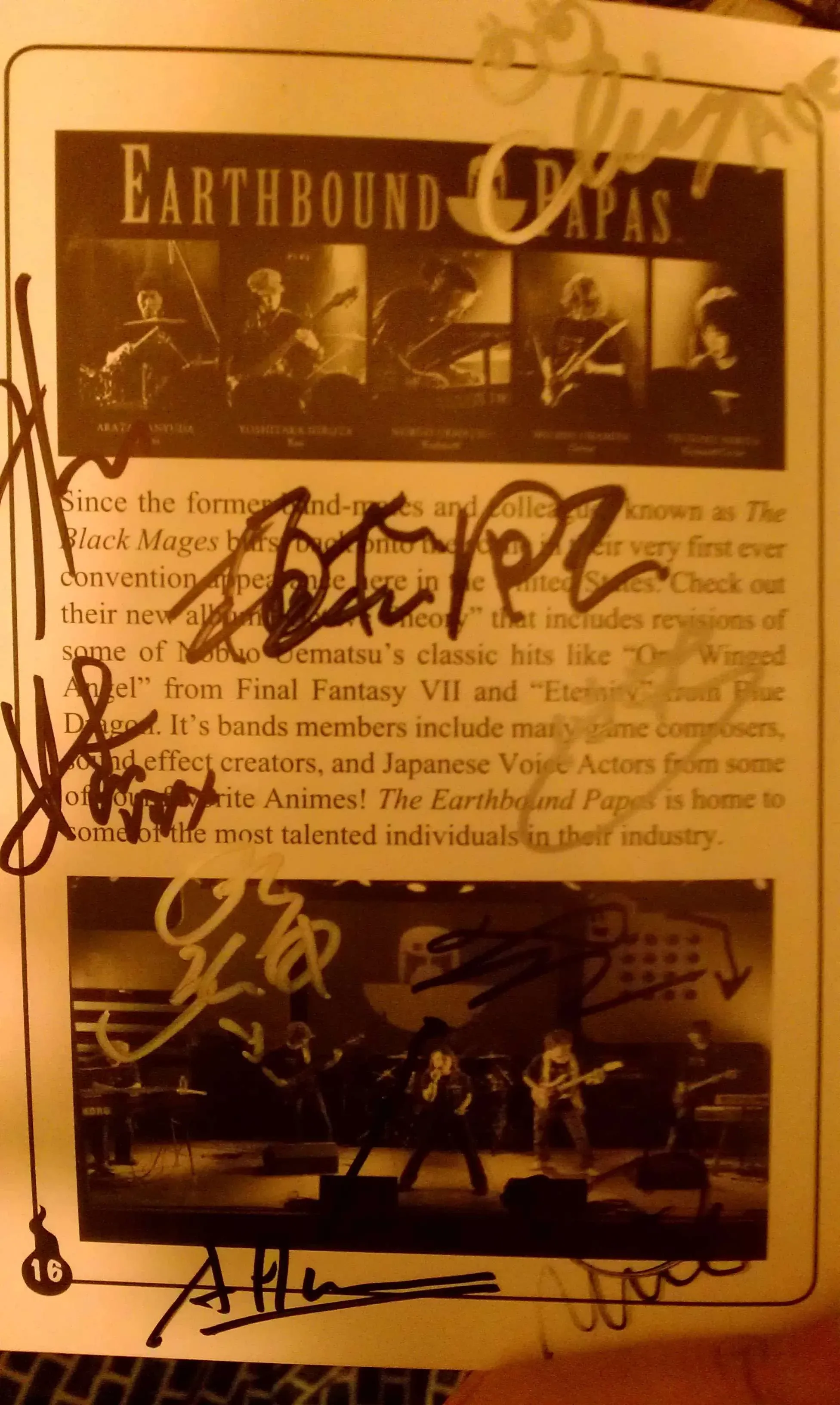
Having attended several iterations of the now more popularized Final Fantasy concert series Distant Worlds (itself named after an incredible and less-heard track from an expansion of Final Fantasy XI), those concerts are indeed beautiful. But to me, nothing has ever topped the three times I was able to see Earthbound Papas in concert. Two of those times were at back-to-back appearances at Oni-Con in Galveston, Texas, years 2011 and 2012 respectively, and one performance at MAGFest also in 2012. At both of the Oni-Con events, all members of Earthbound Papas, Uematsu included, spent time after their concert signing autographs. In 2011, I got my Oni-Con program book signed on the page with the full spread featuring the band. This includes percussionist Chihiro Fujioka (director of Super Mario RPG and also the percussionist of Uematsu's most recent musical group con TIKI) and guitarist Michio Okamiya (a former Square Enix employee and also the guitarist in both The Black Mages and con TIKI).
That first time I met Uematsu, despite having previously lived in Japan and studied Japanese, I was too nervous to try to say anything other than "Hello" and "Thank you." When I had learned that Earthbound Papas would be returning to Oni-Con the following year, I remember telling my husband (then-fiance) that although I regretted not actually having even a small conversation with Uematsu, maybe I didn't need to meet him again because I'd already done it once, and after all, it was just an autograph, and I didn't need another. In the most loving way he could have possibly meant it, my fiance responded by saying, "Kaylyn, don't be a p***y." I really do mean he meant it lovingly, because he impressed upon me that I would be missing out on something that he knew would have meant so much to me, knowing that I knew enough Japanese to at least be able to communicate with Nobuo directly, without having to speak through his interpreter. I tried to argue, "Yeah, but what more would I say than something everybody has already told him? That I'm just such a big fan of his work? There's nothing special about that." He didn't let up, and told me even if it was nothing more than that, that would be enough, and I would be glad I did it.
I found myself cleverly in line for the Earthbound Papas autographs before the concert had actually wrapped up. Having already seen this band twice before, I was okay stepping out just a little bit early to ensure I would definitely see Uematsu again. Oni-Con also had arranged a policy where you were supposed to have bought Earthbound Papas merch specifically if you were going to get it autographed, and I'd already owned a copy of Octave Theory. The poor dude standing in front of me had brought a copy of Rad Racer, the first US-released game on the NES with Uematsu's composition for its soundtrack, but I knew he was going to be turned away because the band was not signing anything that wasn't the merch being sold at the event.
Having once again said thank you to all the other members of the band, I finally got up to Nobuo once again, and handed over my disc to be signed. And from the bottom of my gut, I managed to gather up my strength to use my Japanese to say, "I've seen your band in concert three times now." Uematsu stopped signing and looked up at me with an enormous grin, surely surprised that I was speaking to him in Japanese and not going through his interpreter. He responded likewise in Japanese saying, "Wow! Really? It's been three times now?" He then leaned back in his chair and looked over at all the other members of his band and pointed at me. "Did you hear that? She said she's already seen us three times!" They all looked at me, smiling and chuckling, seeming impressed that anyone had gone out of their way to watch them perform that many times. Uematsu then turned back to me. "Where did you see us? Here?" I replied, "Yes, I saw you here last year. I also saw you at MAGFest." Uematsu looked a little confused, trying to remember which event MAGFest was. His interpreter then jumped in and reminded him, "That was in Washington (D.C.)." I said, "Yes, that's right, that was in Washington." (Although, very technically, MAGFest is held in National Harbor, Maryland, but it was close enough for horseshoes and hand grenades.) Uematsu then had a clear picture of where this was, not remembering the name of the event but remembering he had been to somewhere around Washington D.C. "Oh, that's right! Washington!" He put the finishing touches on his autograph and handed it back to me. "I hope that we can see each other again at another performance in the future." To me, he looked like he was beaming. It wasn't as though he didn't look happy to see other enthusiastic fans, but I got the sense that it was special to him that someone spoke directly to him in a way he could communicate, and that he is humble enough to still be impressed that people would be so excited to see his concerts that they would come to see them so many times.
Another friend that I was in line with would later that night go up to her boyfriend and say, "You should of seen it. She was talking to him. Like, for REAL real, talking to him!"
Mielke's book, Nobuo Uematsu: On The Record, also gave me that sense that this humble nature was Uematsu's true state of mind. Perhaps for many years he wasn't actually sure that his music was standing out to fans, and definitely before the performance of the first Dear Friends concert in Los Angeles he did not understand that the games or even his music had landed so hard with international players. The book certainly makes him seem humble enough that he does not expect super stardom, but now feels fulfilled with a gained sense of confidence that his work has meant something to people now that his concert series' have been met with such popular reception. It comes off as a combination of surprise and satisfaction that in the end the things he has poured his heart into truly do matter to people other than himself. He probably would have kept making the things he wanted to create whether it was received well by others or not, but the fact that it is in fact received well by others is not lost to him, and he does not take it for granted. I think that's why my brief interaction with him came off as meaningful as it did, too. He was so impressed that someone would come back to see him numerous times that he immediately had to turn to the rest of the people in his band to share the joy of learning somebody went out of their way to see them that many times. To him, that's not nothing. That joy means something. And it's the sense I got from him, both in having seen him with my own two eyes and in reading the book, that he is constantly seeking things in this world that spark joy. If there's anything else about Uematsu I envy, it's that he gives that much of a joyful appearance so often. Obviously, he is only human, and there are things in this world that stress him or sadden him, as the book also covers in small doses. But the pursuit of very real human joy in all areas is palpable, and I wish I had more of that in my own life.
What Jumped Out About the Biography
There are two moments near each other in Mielke's book that perhaps were not shocking on their face, only shocking that Uematsu presented them so bluntly.
I don't think it's at all a secret about what the shift in culture was like during the years in which Squaresoft was discussing merging with Enix to later create what is now known as Square Enix, particularly if you have ever read interviews from anyone else who worked at Square prior to and during the time of the merger. Hironobu Sakaguchi had left the company and was already well on his way to forming his current game studio Mistwalker. Many other former employees have noted that management was particularly unstable and rocky with unsettling direction, and simply playing any games (particularly in the Final Fantasy franchise) from that point in time onward will immediately tell you that there was a great shift in focus and philosophy. There was a time where Square was hemorrhaging money, not just from their film endeavor Final Fantasy: The Spirits Within but from other areas that I feel like don't get a lot of focus hardly at all, with the movie taking the brunt of the blame for the financial failure (I sometimes think unfairly, because, again, it wasn't the company's only problem at the time). Square was in a panic mode, trying to save their potential merger with Enix, and the company had been increasingly relying on higher-fidelity games with an intense focus on dazzlingly stunning graphics above all else. Sakaguchi always had a philosophy of never trying to make direct sequels to his games, because as a creator he believed that when you make a good piece of art, you put it all out there and then you move on to make something new.
But management toward the end of Sakaguchi's career at Square, and certainly in the years after his leaving, were much more focused on financial earnings. Even before the merger, Square was looking to take the company public. Money was a huge driver in everything they were doing. And capitalism quite frankly is the direct enemy of any artist. So when Final Fantasy X-2 was announced, I remember feeling like that was the first time I was ever genuinely worried about the direction of the Final Fantasy franchise. Even if it turned out to be good (and in the end I did at least think it was a fun game to play), it was clearly a wild departure from everything this development team would have stood for in the past. My feelings on this were only further emboldened when I later learned that Square Enix was developing a movie based on Final Fantasy VII. At first, I believed that a film adaptation of the plot of the game could actually be fun to watch. But then the official website kept updating, and as I learned the details of the film--a sequel taking place two years after the events of the game--my heart began to sink. And by the time Final Fantasy VII: Advent Children actually launched, it was clear to me that it was not made because somebody believed it was a worthy piece of art that genuinely belonged in the narrative of Final Fantasy VII's greater world, but rather that it was prodding super fans of the game who desperately wanted to see Cloud and Sephiroth fight each other in the highest fidelity possible. In other words, it only existed to make money. There are people who do love that movie, and I don't want to go out of my way to steal anyone's joy, but given I feel like over the years I have grown to understand the views of many of the creators of Square's older games, it felt like something none of the artists with any integrity who would be unswayed by the paycheck would have willingly made.
Nobuo Uematsu addresses this period of time directly in Nobuo Uematsu: On The Record. I once again do not want to give away the preciseness of what is stated in the book because I think you should read it for yourself. However, his directness on the topic was surprising to me. I think his feelings probably make a lot of sense and aren't so surprising, but still, seeing him state it all so bluntly is what truly caused me to gasp. He speaks directly of the management and the types of people who stuck around in the transition from Square to Square Enix, speaking frankly quite bitterly about the nature of the employees that remained, and paints a picture of an environment that is in direct opposition to any artist trying to create art with any level of integrity. Furthermore, Uematsu makes his feelings about Advent Children that much more clear. I'll only say that the word "crap" is used to describe what amount of Advent Children Uematsu watched, and that he did not believe they should even have been making the movie at all. It's interesting, then, because Uematsu does have new musical contributions to that movie, including an updated version of One-Winged Angel with new Latin lyrics and a new rock band movement in the middle performed by The Black Mages. As cool as many people think that version of One-Winged Angel is, I can't help but wonder if Uematsu felt an obligation to work on it, rather than having it come about naturally, organically, and willingly. I think it's important for me to at least let you know that, while he told another member of the movie's team his feelings about the project, he now regrets how he said it to them. I think noting that speaks a lot about Uematsu's character.
"Advent: One-Winged Angel", the arrangement of the song "One-Winged Angel" created specifically for the animated film "Final Fantasy VII: Advent Children".
What the Book Leaves Me Feeling
Nobuo Uematsu: On The Record paints a picture of Uematsu that shows his true personality, along with the way his closest collaborators truly feel about him after years of working and collaborating with him. It's hard to find anyone speaking ill about him, as his collaborators also note. He's just a really well-liked dude with a quirky personality that is all smiles when he's not working, but all business when it's time to crack down on getting work done. We get to see who he is as a person with all different kinds of flights of fancy, a curious eye, and an eclectic taste in music.
I've found learning more about his thoughts on UFOs and the occult to be very endearing. Although I don't know if I believe in much occult myself (aside from having no choice but to believe in UFOs--or more accurately now, UAPs--thanks to our government admitting that something unidentified truly does exist), but I do like the simple idea of them. I have spent most of my life enjoying and creating characters that are aliens, and one of my earliest deep attachments was to the Looney Tunes character Marvin the Martian. I collected what was probably an unhealthy amount of Marvin the Martian merchandise as a child, and I still have most all of it in storage somewhere, including a five-foot cardboard cutout of the character. Seeing a photo in the book of Uematsu wearing a Marvin the Martian shirt made me feel that much more endeared to him. And listening to him talk about UFO sightings and visiting landing sites was very familiar to me as well. The topic of Area 51 comes up in the book, and while I mostly took this visit as a joke during a popular internet event, I myself wore a Marvin the Martian shirt out to a truck stop near Area 51 in Nevada and took a picture. Even if I'm not sure that aliens themselves are real, I think they're a fun concept and that locations with a lot of mystery like this are just plain fun.
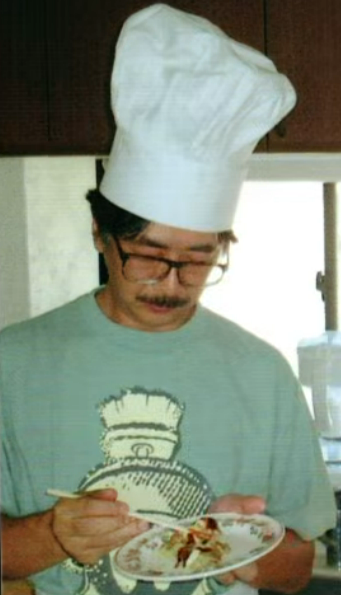
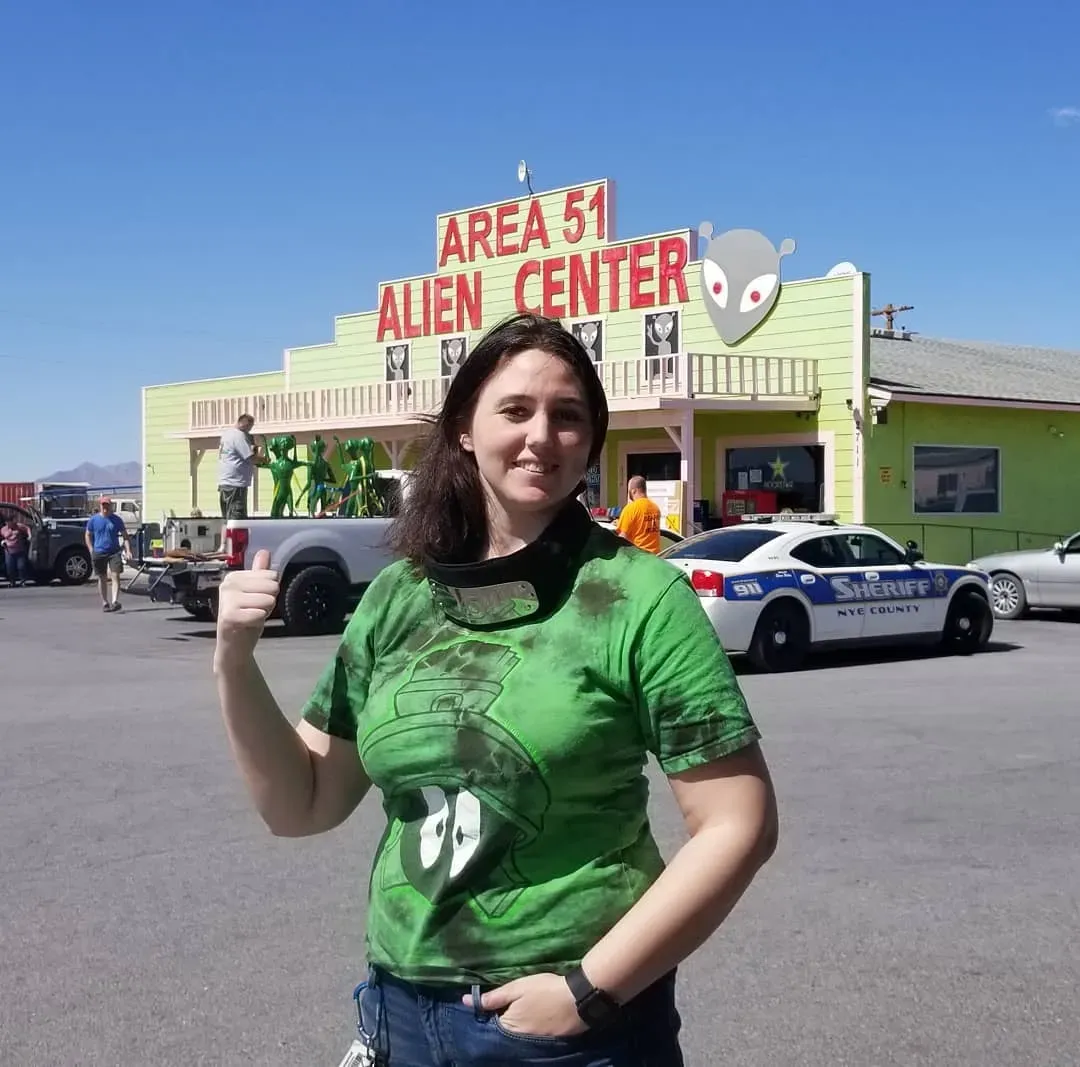
Left, screenshot of a photo of Nobuo Uematsu wearing a Marvin the Martian T-shirt comes from the video trailer for the book "Nobuo Uematsu: On The Record", and the photo is also featured in the book. Right, a photo of me wearing a shirt with the same art of Marvin the Martian as I stand in front of the Area 51 Alien Center in Nevada.
James Mielke is a wonderful interviewer and writer for this biography. There is a casual, conversational nature to his interviews not just with Nobuo Uematsu but also with Uematsu's wife Reiko, Hironobu Sakaguchi, and numerous other figures from Square/Square Enix and other collaborators. This book comes after a long career of video game journalism from Mielke which surely has contributed to his trustworthiness in the interview and writing process. Even knowing that I needed to take breaks to get my own work done, I finished reading the book in under three days, which is pretty fast for me. I thought I would be working on reading it over the weekend, but my eagerness to consume the information in the book had me finishing it during the week even when I had other things I needed to do, leaving me time to write all this over the weekend instead.
Reading about Uematsu's approach to life and music has me reevaluating my own approach to life and music. It makes me wish I'd had the gumption to press on musically because there was music I was passionate about, rather than giving up because other people had different expectations of me. But it also leaves me hoping that despite now reaching middle-age, maybe it's not too late for me after all. I still have access to the musical instruments I had trained on in my past, and maybe I can not only recover that lost skill but also push further in the direction I always wanted way back when. Maybe I can eventually find others who are looking for the same thing. Maybe I can still find that joy.
The last time I was in the same room as Nobuo Uematsu was at the Tokyo Game Show in 2024. Fantasian was finally expanding out past its entrapment on Apple Arcade to reach console and PC players as Fantasian: Neo Dimension, published by Square Enix. It marked the return of Hironobu Sakaguchi to working collaboratively with Square Enix, thanks in large part to Naoki Yoshida, producer of Final Fantasy XIV. After waiting in a long line to play a demo of Fantasian: Neo Dimension (and watching as Sakaguchi walked right past my shoulder during that wait), there was a presentation by Naoki Yoshida featuring a conversation with both Hironobu Sakaguchi and Nobuo Uematsu about the game finally getting a wider publication through Square Enix. At the end of the presentation, the three of them took a friendly picture with the crowd of people watching from below the stage. And it just so happens that I was one of the faces in that crowd. I am incredibly small and blurry in the photo, but I can certainly say I am in fact in that photo with all of them. It is a moment that brings me great joy.
I may never meet Nobuo Uematsu again. But if I did, I would hope that it's more than just an autograph-style experience. I think that now that I've realized I can have more musical freedom, that would be something I just wish I could talk to someone like him about. Or to really express how much a song like Forest of Thousand Years from his Earthbound Papas days means to me, beyond anything from a video game. For now, I know the next time I will see him live will be at the Los Angeles stop on his con TIKI tour on October 31st, just a little over a month away. The meet and greet tickets are already completely sold out, and although that's disappointing, I suppose I'm not sure I need to talk again in a meet and greet-style setting if I've already had the short autograph-style conversation with him. I think I will be happy just to hear him performing again, finally playing at his absolute best, most honed version of himself that he has become musically. If these opportunities keep showing up, I will keep showing up, too. That's how lasting an impression his music has made on my life over the course of decades. And I can't wait to see what comes next.
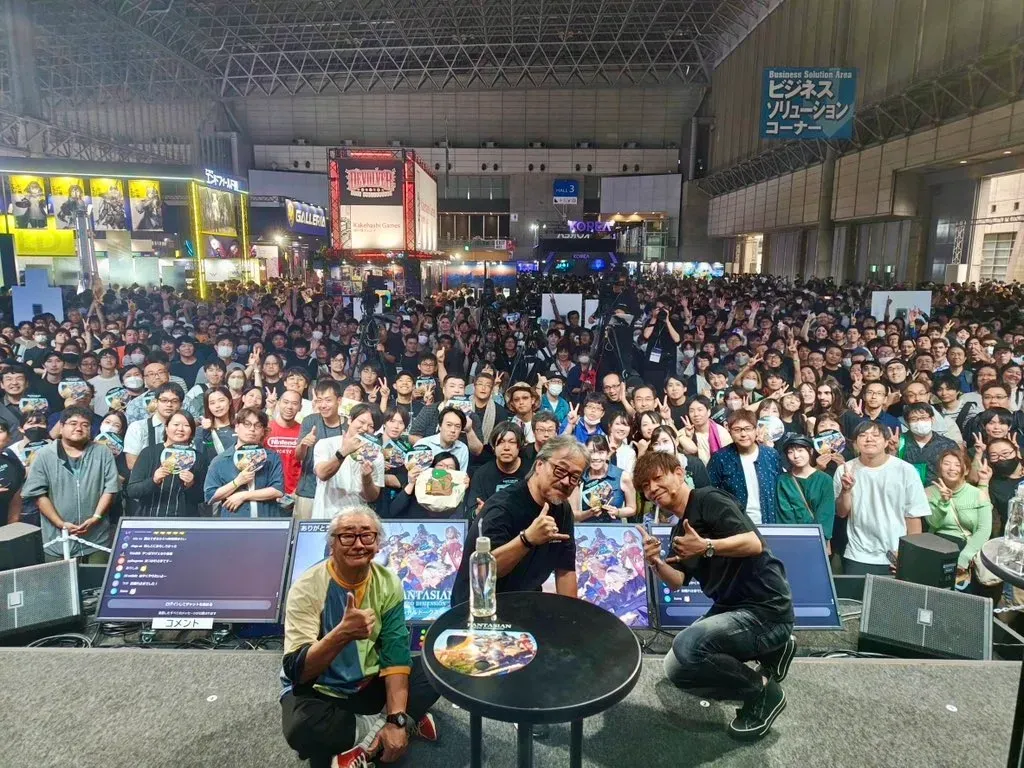
Left, from left to right, a photo of Nobuo Uematsu giving a thumbs up, Hironobu Sakaguchi throwing up a shaka hand sign, and Naoki Yoshida throwing up two shaka hand signs in front of a crowd at the Tokyo Game show in 2024. Right, a tighter and blurrier shot of me deep in the crowd at Tokyo Game Show in 2024 from the picture on the left, raising my hand in a shaka.
